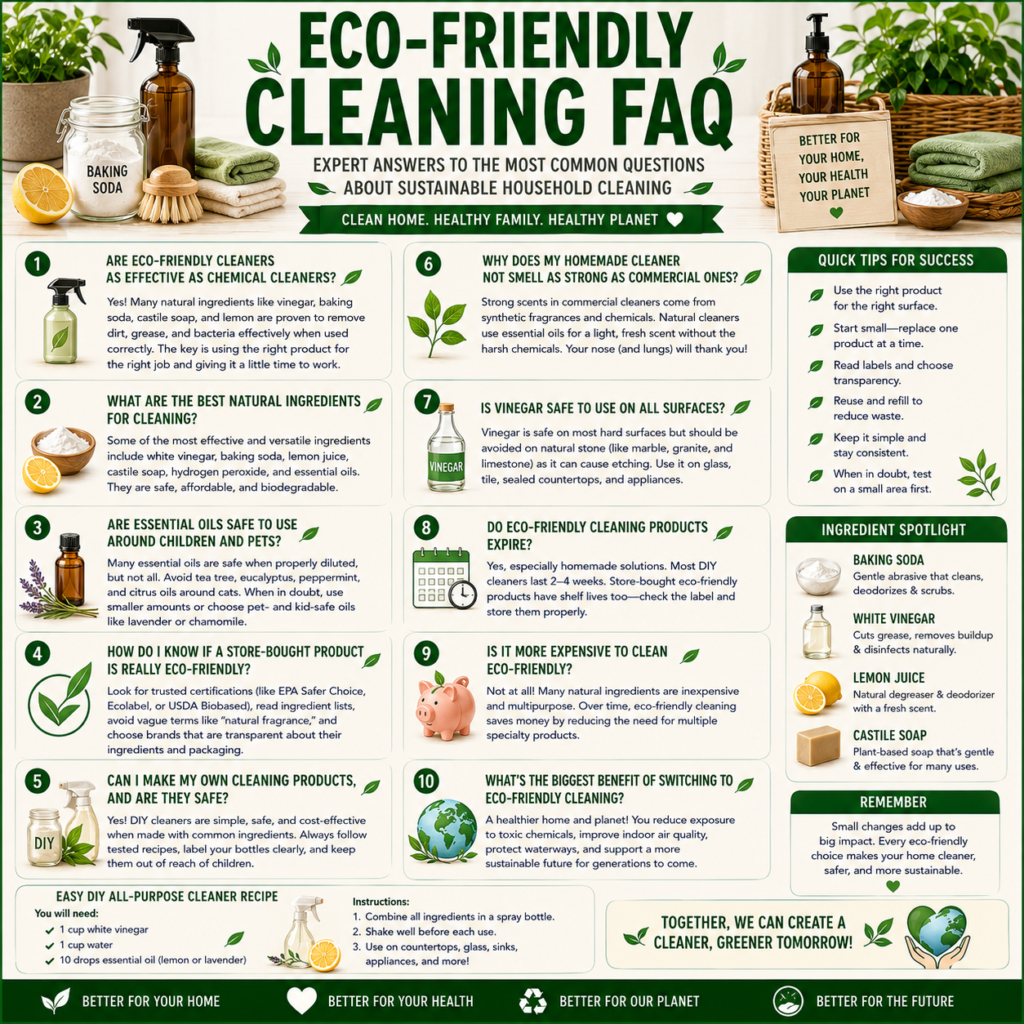
CATEGORY: Eco-Friendly Cleaning
Eco-friendly cleaning has become an important part of modern home care as more people seek practical ways to reduce waste, improve indoor air quality, and make environmentally responsible choices. However, many homeowners still have questions about how environmentally friendly cleaning products work, whether they are effective, how to build sustainable cleaning routines, and which everyday habits have the greatest impact.
This comprehensive FAQ answers many of the most frequently asked questions about eco-friendly cleaning, helping homeowners make informed decisions while creating cleaner, healthier, and more sustainable living spaces.
What is eco-friendly cleaning?
Eco-friendly cleaning is the practice of maintaining a clean home while reducing unnecessary environmental impact.
It typically involves:
- Choosing environmentally responsible products.
- Using reusable cleaning tools.
- Reducing plastic waste.
- Conserving water.
- Following sustainable cleaning habits.
- Maintaining regular cleaning routines.
The goal is to balance effective household cleaning with responsible resource use.
Does eco-friendly cleaning actually work?
Yes.
Modern environmentally responsible cleaning products can be highly effective for routine household cleaning when used correctly and according to the manufacturer’s instructions.
The quality of the product, the cleaning method, the tools used, and regular maintenance all influence the final result.
Is eco-friendly cleaning more expensive?
Not necessarily.
Although some environmentally friendly products may have a higher initial purchase price, many households save money over time by using:
- Concentrated products.
- Refillable containers.
- Reusable microfiber cloths.
- Washable mop pads.
- Durable cleaning equipment.
Long-lasting products often reduce overall household expenses.
Are natural cleaning products always better?
Not always.
Some natural products perform extremely well for certain cleaning tasks, while others may not be suitable for every surface or situation.
The most important factor is selecting the appropriate product for the intended use and following the manufacturer’s recommendations.
Are natural products always safe?
No.
Natural ingredients can still cause allergic reactions, skin irritation, or damage to certain materials.
All cleaning products should be:
- Used according to instructions.
- Stored safely.
- Kept away from children.
- Kept away from pets.
Reading product labels remains essential.
Can I clean my whole house with only one product?
Some multi-purpose cleaners are suitable for many household surfaces.
However, certain materials—including natural stone, untreated wood, electronic equipment, and specialty finishes—often require products specifically designed for those surfaces.
Always follow the manufacturer’s guidance.
What are reusable cleaning tools?
Reusable cleaning tools are designed for repeated use rather than disposal.
Examples include:
- Microfiber cloths.
- Refillable spray bottles.
- Washable mop pads.
- Durable scrubbing brushes.
- Washable dusters.
Proper maintenance allows many of these items to remain effective for years.
How often should reusable cloths be washed?
Reusable cloths should be cleaned regularly according to the manufacturer’s care instructions.
Cleaning frequency depends on:
- How heavily they are used.
- The surfaces cleaned.
- Household hygiene requirements.
Well-maintained cloths remain more effective and hygienic.
Should I use paper towels?
Paper towels remain useful for certain situations.
However, replacing routine cleaning tasks with reusable cloths can significantly reduce household waste and long-term costs.
Many households reserve paper towels for occasional use rather than everyday cleaning.
How can I reduce plastic waste while cleaning?
Simple improvements include:
- Purchasing refill packs.
- Choosing concentrated products.
- Reusing spray bottles.
- Selecting recyclable packaging.
- Buying durable cleaning equipment.
Gradual improvements often produce meaningful long-term reductions in waste.
How can I save water while cleaning?
Helpful water-saving habits include:
- Filling a bucket instead of running the tap continuously.
- Cleaning spills immediately.
- Washing full loads of reusable cloths.
- Repairing leaking taps.
- Using only the amount of water required.
Small daily improvements contribute to significant long-term conservation.
Are eco-friendly products suitable for every surface?
No.
Every surface has different care requirements.
Always check manufacturer recommendations before cleaning materials such as:
- Marble.
- Granite.
- Natural wood.
- Leather.
- Electronic equipment.
- Specialty finishes.
Testing any unfamiliar product on a hidden area first is generally advisable.
What is the best cleaning schedule?
Although every household is different, a practical routine often includes:
Daily
- Wipe work surfaces.
- Clean spills.
- Tidy clutter.
Weekly
- Vacuum or sweep.
- Mop floors.
- Clean bathrooms.
- Dust furniture.
Monthly
- Deep-clean appliances.
- Organize storage areas.
- Wash windows.
- Clean light fixtures.
Consistency usually reduces the need for intensive cleaning.
Can eco-friendly cleaning improve indoor air quality?
Many homeowners choose environmentally responsible products because some formulations are designed to reduce strong chemical odors associated with certain conventional cleaners.
Good ventilation, regular dust removal, and moisture control also contribute to a fresher indoor environment.
Is eco-friendly cleaning suitable for homes with pets?
Yes.
Many households with pets successfully use environmentally responsible cleaning products.
However, all cleaning products should be:
- Used exactly as directed.
- Stored safely.
- Allowed to dry where appropriate before pets return to cleaned areas.
Always follow any safety guidance provided by the manufacturer.
How should cleaning products be stored?
Store cleaning supplies:
- In their original containers.
- Clearly labelled.
- Out of reach of children.
- Away from pets.
- According to manufacturer recommendations.
Never transfer products into unmarked bottles.
Do I need separate cleaners for every room?
Not necessarily.
Many households successfully use a small number of versatile products suitable for multiple approved surfaces.
Buying fewer, high-quality products often reduces waste, saves storage space, and simplifies cleaning routines.
Are homemade cleaning solutions always better?
Homemade solutions can be useful for certain household tasks but are not automatically suitable for every material or cleaning situation.
Always verify that any cleaning solution is compatible with the surface being cleaned.
Following manufacturer recommendations remains the safest approach.
What is the biggest mistake people make?
One of the most common mistakes is believing that using more product automatically produces better cleaning results.
In reality, excessive product may:
- Leave residue.
- Increase waste.
- Require additional rinsing.
- Raise household costs.
Following the recommended dosage is generally the most effective approach.
How can beginners start eco-friendly cleaning?
The simplest approach is to make gradual improvements.
Many homeowners begin by:
- Replacing disposable cloths with reusable ones.
- Purchasing refillable cleaning products.
- Choosing concentrated detergents.
- Reducing unnecessary packaging.
- Following a regular cleaning schedule.
Small changes repeated consistently often become lasting habits.
What is the most important principle of eco-friendly cleaning?
The single most important principle is thoughtful, consistent use of resources.
This includes:
- Buying only what you need.
- Maintaining reusable equipment.
- Cleaning regularly.
- Conserving water.
- Reducing waste.
- Choosing durable products.
- Following manufacturer instructions.
Sustainability is built through everyday habits rather than dramatic changes.
Final Thoughts
Eco-friendly cleaning is a practical and achievable approach to maintaining a healthier, cleaner home while reducing unnecessary environmental impact. Through informed product choices, reusable cleaning tools, responsible resource use, and consistent household routines, homeowners can enjoy excellent cleaning results without creating excessive waste.
The journey toward sustainable cleaning does not require perfection. Small improvements made over time often have the greatest long-term effect. Whether you are just beginning or refining an existing routine, every environmentally responsible choice contributes to a cleaner home, lower household waste, and a more sustainable future.
—
The End
HavenBearing.com
 Discover More From Our Family of Websites
 ZodiacBearing (Astrology, Tarot, Numerology, Angel Numbers & Spiritual Guidance)
 Velourana (Beauty, Makeup, Hair Care, Skincare & Beauty Tips)
 HavenBearing (Home, Living, Organization, Décor & Everyday Inspiration)
 PawBearing (Pet Care, Dog Breeds, Animal Health, Training & Pet Products)
 PsyCatherine (Notes From the Journal of a Psychologist on Real Life)