CATEGORY: Eco-Friendly Cleaning
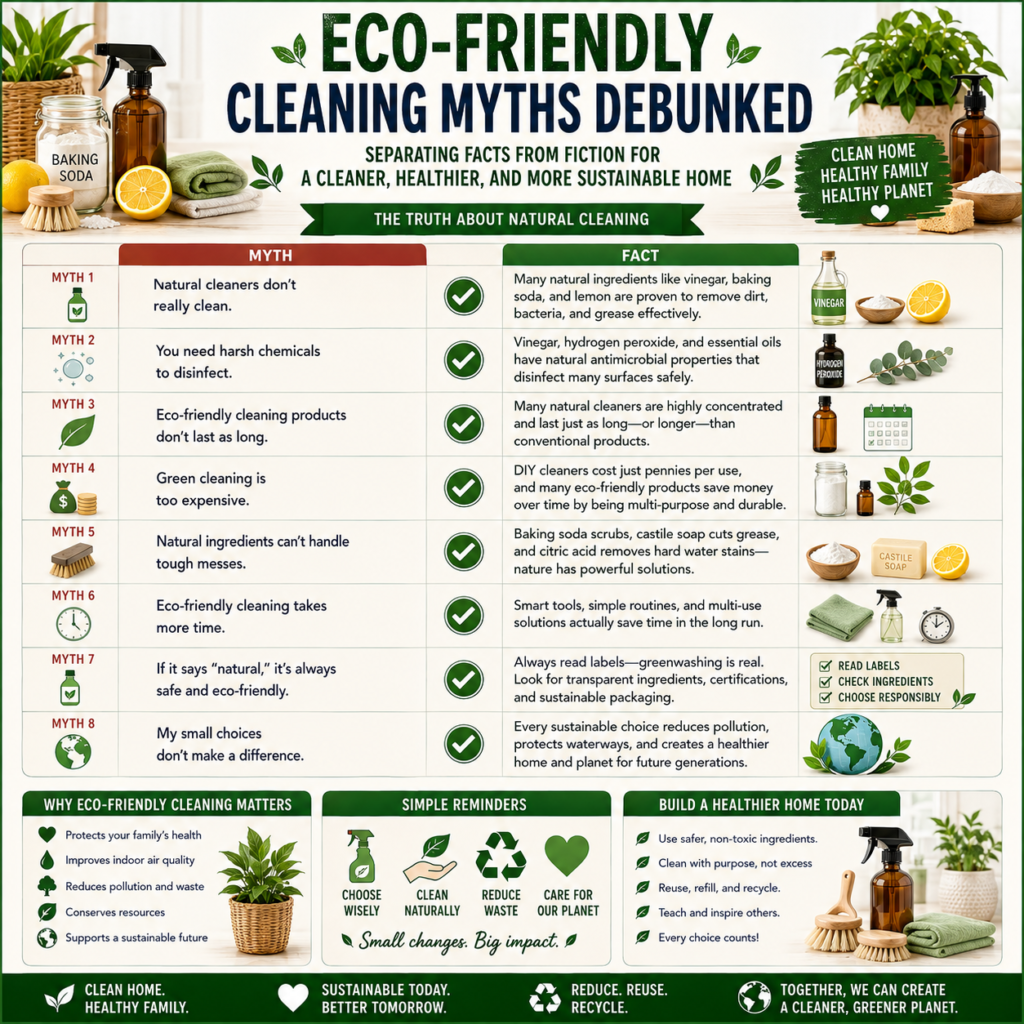
Eco-friendly cleaning has become increasingly popular as more people look for ways to reduce household waste, improve indoor air quality, and make environmentally responsible choices. However, with growing interest has also come a growing number of myths, misunderstandings, and misleading marketing claims. Some people believe environmentally friendly cleaning products are ineffective, while others assume that anything labelled “natural” is automatically safe or suitable for every purpose.
The reality is much more balanced. Eco-friendly cleaning can be highly effective when products are used correctly and matched to the appropriate cleaning task. Understanding the facts behind common misconceptions allows homeowners to make informed decisions based on evidence rather than assumptions.
This guide examines many of the most widespread myths surrounding eco-friendly cleaning, explaining what is true, what is misleading, and how to create a cleaning routine that is both effective and environmentally responsible.
Myth 1: Eco-Friendly Cleaning Doesn’t Work
This is perhaps the most common misconception.
Many people assume that products made with environmentally responsible ingredients must be weaker than conventional alternatives.
In reality, cleaning effectiveness depends on several factors, including:
- Choosing the correct product.
- Following the manufacturer’s instructions.
- Using appropriate cleaning tools.
- Allowing sufficient contact time where recommended.
- Regular maintenance.
For routine household cleaning, many eco-friendly products perform extremely well when used as directed.
Myth 2: Natural Means Completely Safe
Natural ingredients are often perceived as harmless simply because they originate from plants or naturally occurring substances.
However, natural does not automatically mean risk-free.
Some naturally derived ingredients may:
- Irritate sensitive skin.
- Trigger allergies.
- Damage certain surfaces.
- Require careful storage.
All cleaning products—whether natural or synthetic—should always be used according to the manufacturer’s instructions.
Myth 3: You Need Dozens of Cleaning Products
Marketing often encourages homeowners to purchase a separate cleaner for every room and every surface.
In practice, many households successfully maintain their homes using a relatively small number of versatile products that are suitable for multiple approved surfaces.
This approach helps:
- Reduce plastic waste.
- Simplify storage.
- Lower household expenses.
- Reduce unnecessary consumption.
Always ensure each product is appropriate for the intended surface before use.
Myth 4: More Product Cleans Better
Using extra cleaning product rarely improves results.
Excess product may actually:
- Leave residue.
- Require additional rinsing.
- Waste money.
- Increase packaging waste.
Following the manufacturer’s recommended dosage is usually the most effective approach.
Myth 5: Disposable Wipes Are More Hygienic
Disposable wipes are convenient, but convenience does not necessarily make them superior.
Properly washed reusable microfiber cloths and reusable cleaning tools can provide excellent cleaning performance when maintained according to the manufacturer’s care instructions.
Choosing reusable equipment also significantly reduces household waste.
Myth 6: Eco-Friendly Cleaning Is Expensive
Some environmentally responsible products cost more initially.
However, sustainable cleaning often reduces long-term expenses through:
- Refillable containers.
- Concentrated products.
- Reusable cloths.
- Durable brushes.
- Lower paper towel consumption.
Many households discover that eco-friendly cleaning becomes more economical over time.
Myth 7: Homemade Cleaners Are Always Better
Some homeowners enjoy preparing their own cleaning solutions.
While homemade cleaners may be suitable for certain routine tasks, they are not automatically appropriate for every surface or cleaning situation.
Different materials require different care.
For example:
- Natural stone surfaces often require specialized products.
- Wood finishes may require manufacturer-approved cleaners.
- Electronic equipment often needs carefully selected cleaning methods.
Understanding surface compatibility remains essential regardless of whether a cleaner is homemade or commercially produced.
Myth 8: Eco-Friendly Homes Never Use Plastic
Plastic reduction is an important sustainability goal, but eliminating plastic entirely is often unrealistic.
Instead, eco-friendly households frequently focus on:
- Reusing containers.
- Purchasing refill packs.
- Choosing durable products.
- Recycling responsibly.
Reducing unnecessary plastic consumption generally has a greater practical impact than attempting complete elimination.
Myth 9: Cleaning Less Helps the Environment
Reducing unnecessary cleaning products is sensible.
Reducing necessary cleaning is not.
Regular maintenance:
- Extends the life of household surfaces.
- Prevents heavy dirt accumulation.
- Reduces the need for intensive cleaning later.
- Helps maintain healthy living spaces.
Routine cleaning is usually more sustainable than allowing problems to become severe.
Myth 10: Eco-Friendly Products Never Contain Synthetic Ingredients
Many environmentally responsible products combine naturally derived ingredients with carefully selected synthetic components to improve stability, preservation, or performance.
The overall formulation, responsible manufacturing, and intended environmental impact are often more meaningful than whether every ingredient originates directly from nature.
Myth 11: Sustainable Cleaning Takes More Time
Some people assume environmentally friendly cleaning requires complicated routines.
In reality, sustainable cleaning often emphasizes:
- Daily maintenance.
- Simple habits.
- Reusable equipment.
- Multi-purpose products.
- Better organization.
These approaches frequently reduce cleaning time rather than increase it.
Myth 12: Eco-Friendly Cleaning Is Only About Products
Perhaps the biggest misconception is that sustainability begins and ends with purchasing different cleaning liquids.
True eco-friendly cleaning also includes:
- Conserving water.
- Reducing energy use.
- Using reusable equipment.
- Preventing waste.
- Maintaining household items.
- Buying durable products.
- Repairing rather than replacing whenever practical.
Lifestyle habits often have a greater environmental impact than product selection alone.
Understanding Marketing Claims
Product packaging sometimes uses terms such as:
- Green.
- Natural.
- Eco.
- Plant-based.
- Sustainable.
While these descriptions may be helpful, consumers should also consider:
- Ingredient transparency.
- Packaging design.
- Refill availability.
- Manufacturer guidance.
- Surface compatibility.
Reading labels carefully provides more reliable information than relying solely on marketing language.
Building an Evidence-Based Cleaning Routine
The most effective cleaning routine combines practical knowledge with thoughtful purchasing decisions.
Successful eco-friendly households often:
- Buy only what they need.
- Maintain reusable equipment.
- Follow product instructions.
- Store products correctly.
- Clean regularly.
- Repair tools when practical.
- Recycle responsibly.
Small improvements practiced consistently often produce the greatest long-term results.
Why Balance Matters
Sustainability is not about perfection.
Attempting to eliminate every conventional product immediately can become expensive, frustrating, and unrealistic.
Instead, gradual improvements allow homeowners to:
- Learn what works.
- Reduce unnecessary waste.
- Build lasting habits.
- Improve efficiency over time.
Progress is far more valuable than unrealistic expectations.
Final Thoughts
Eco-friendly cleaning is supported by practical habits, informed decisions, and realistic expectations rather than myths or marketing promises. Understanding what environmentally responsible products can and cannot do helps homeowners develop routines that are effective, economical, and sustainable.
Rather than focusing on perfection, successful eco-friendly cleaning encourages gradual improvements that become permanent habits. Choosing durable tools, reducing waste, using products responsibly, and maintaining regular cleaning schedules all contribute to cleaner homes and a healthier environment. By separating facts from fiction, homeowners can confidently make choices that benefit both their families and the planet.
—
The End
HavenBearing.com
 Discover More From Our Family of Websites
 ZodiacBearing (Astrology, Tarot, Numerology, Angel Numbers & Spiritual Guidance)
 Velourana (Beauty, Makeup, Hair Care, Skincare & Beauty Tips)
 HavenBearing (Home, Living, Organization, Décor & Everyday Inspiration)
 PawBearing (Pet Care, Dog Breeds, Animal Health, Training & Pet Products)
 PsyCatherine (Notes From the Journal of a Psychologist on Real Life)